
You Check Your Teeth. Why Not Your Relationship? The Case for a Neurodiverse Relationship Check-Up.
Updated: 3 days ago
By Harry Motro Clinical Director, Neurodiverse Couples Counseling Center
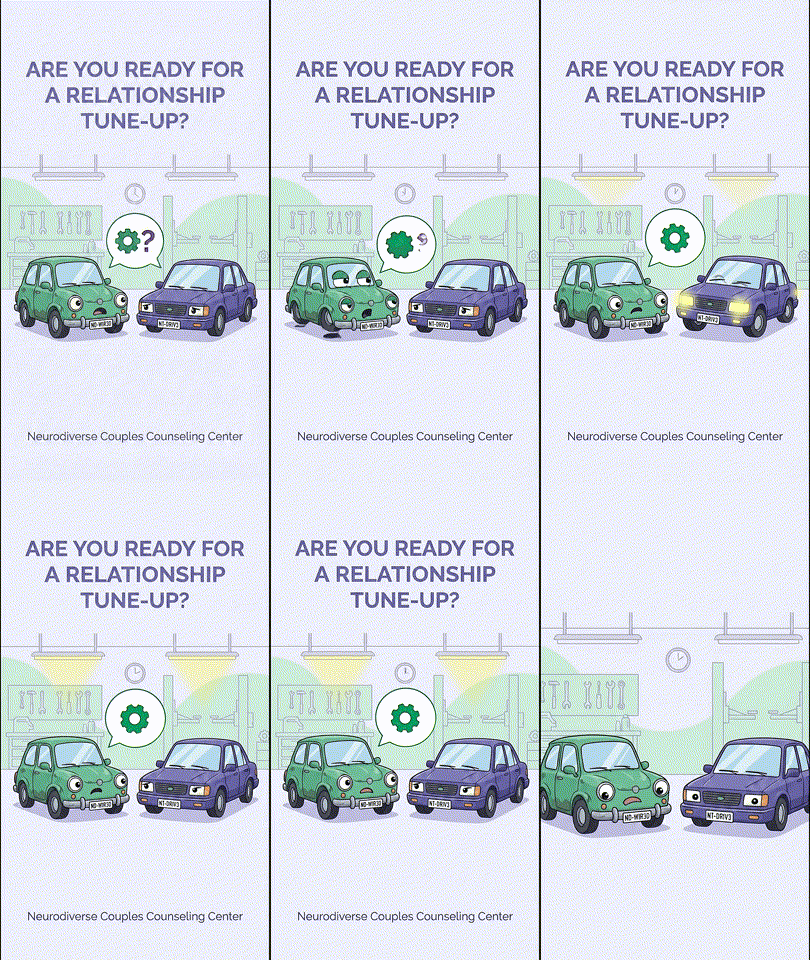
You take your car in for an oil change every 5,000 miles.
You see the dentist twice a year.
You go for your annual physical to check your cholesterol and blood pressure.
We do maintenance on everything that matters to us.
Everything, that is, except the most complex thing in our lives: our relationship.
In my practice at the Neurodiverse Couples Counseling Center, I see thousands of couples—usually one Autistic or ADHD partner and one Neurotypical partner—who are deeply in love but critically exhausted. They usually arrive at our door only after a breakdown.
They have tried standard marriage counseling. They have tried "date nights." They have tried "listening more." But the conflict remains.
Why? Because they are trying to run Windows software on a Mac operating system without an emulator. They don't need to try harder; they need a better map of their wiring.
The Myth of "Meeting in the Middle"
Standard relationship advice suggests that if you compromise, you will find peace. In a neurodiverse relationship, "meeting in the middle" often results in Mutual Masking.
The Autistic/ADHD partner suppresses their sensory needs and stims to appear "attentive," leading to burnout.
The Neurotypical partner suppresses their need for emotional reciprocity to avoid triggering a meltdown, leading to loneliness (often called the "Cassandra Syndrome").
This isn't a lack of love. It is a classic example of the Double Empathy Problem (Milton, 2012). Research shows that while autistic people communicate effectively with other autistic people, and neurotypicals with neurotypicals, the breakdown occurs between the two neurotypes.
It is a translation error, not a character flaw.
Introducing the Neurodiverse Relationship Check-Up
To help couples stop guessing and start understanding, we developed the Neurodiverse Relationship Check-Up.
This isn't a "Cosmopolitan Magazine" quiz. It is a clinical tool designed to map the specific friction points between two different nervous systems.
It analyzes your relationship across three critical layers: Core Dynamics, Communication Style, and Sensory Profiles.
Here is what we are looking for when you take the check-up:
Layer 1: The Core Dynamic (Your Archetype)
Based on our scoring logic, most couples fall into one of three "Survival Loops," or hopefully, the fourth "Secure" state.
Type A: The Logic vs. Emotion Loop (The Cassandra Dynamic)
The Pattern: One partner (often Neurotypical) pursues connection and emotional validation. The other partner (often Autistic/ADHD) retreats into facts, logic, and problem-solving to feel safe.
The Internal Experience:
Partner A: "I am lonely. I am screaming in a glass box. My feelings are treated as math problems."
Partner B: "I am overwhelmed. I am trying to fix the problem to make them happy, but I am constantly told I am doing it wrong."
The Science: This dynamic is fueled by Alexithymia (difficulty identifying feelings) and different processing speeds. The "Logic" partner needs time to process emotion; the "Emotion" partner needs immediate responsiveness to feel safe.
Type B: Parallel Lives (Sensory Survival Mode)
The Pattern: You have stopped fighting. In fact, you barely interact. You have become roommates who manage the logistics of a household but share no intimacy.
The Internal Experience: You have learned that "Space = Safety." To avoid sensory overload or conflict, you drift apart.
The Risk: This creates a stable but "dead" relationship. It is often a coping mechanism for Sensory Overload. One partner retreats to a cave (video games, hobbies) to regulate, leaving the other feeling abandoned.
Type C: The High-Intensity Cycle
The Pattern: Common in ADHD-ADHD or ADHD-Autistic pairings. The relationship is a rollercoaster of dopamine-fueled passion and chaotic, impulsive conflict.
The Internal Experience: "We can't live with each other, and we can't live without each other." Executive function challenges lead to a chaotic home environment, where one person often gets stuck as the "Project Manager," breeding resentment.
Type D: Bridging Differences (The Neuro-Secure Partnership)
The Goal: This is what a healthy neurodiverse relationship looks like.
The Shift: You have stopped trying to "fix" each other's brains. You practice Translation over Transformation.
Curiosity First: "Are you regulated?" replaces "Why are you yelling?"
Explicit Clarity: You say exactly what you mean, removing the anxiety of guesswork.
Layer 2: Communication Style
The check-up also acts as a mirror for how you miss each other.
Mutual Masking is a major red flag we look for. This happens when both partners are walking on eggshells. Research by Lai et al. (2017) shows that "camouflaging" or masking leads to higher rates of anxiety and depression. If your relationship requires you to hide your autistic traits or your emotional needs to survive dinner, the relationship health score will drop.
We also look for Silent Scripts. This occurs when you assume you know what your partner is thinking ("They are being quiet because they are mad at me"), rather than checking the facts ("They are quiet because they are socially tapped out").
Layer 3: The Sensory Profile
This is the most overlooked aspect of couples therapy. We cannot talk about emotion without talking about biology.
The Check-Up analyzes your Sensory Compatibility:
Sound: Does one partner need music to focus while the other needs silence?
Touch Saturation: By 8:00 PM, an Autistic partner may be "touched out" (tactile defensiveness). If the Neurotypical partner tries to hug them, they flinch. This is often interpreted as rejection, but it is actually sensory regulation.
Co-Regulation: How do you calm down? One may need to pace and stim; the other may need to verbalize and process.
Why Take the Check-Up?
You cannot fix a dynamic you cannot name.
The Neurodiverse Relationship Check-Up takes about 5 minutes. It provides you with a Relationship Health Score (0-100%) and a detailed breakdown of your Archetype.
0-40%: Needs Attention (Maladaptive patterns are dominant).
41-75%: Moderate Strain (You have tools, but are frequently triggered).
76-100%: Thriving (You are bridging differences successfully).
This is not a diagnostic tool for Autism or ADHD. It is a diagnostic tool for the relationship itself. It is a starting point for a new kind of conversation—one based on neurology, not blame.
Go deeper: When the check-up shows strain, start with Module 3, Your Goals, in our free Neurodiverse Couples Repair Program. Module 29, Knowing When to Come Back, covers the check-ins that follow.
Stop guessing. Get the map.

Harry Motro
Clinical Director, Neurodiverse Couples Counseling Center
© 2025 New Path Family of Therapy Centers Inc. All rights reserved. No portion of these statements may be reproduced, redistributed, or used in any form without explicit written permission from the New Path Family of Therapy Centers.
Want to learn more about yourself?
Explore our sister site, Adult Autism Assessment, and take a deeper dive into your journey of self-discovery. Click the links below to get started!
References & Further Reading
Baron-Cohen, S., et al. (2001). The "Reading the Mind in the Eyes" Test revised version: a study with normal adults, and adults with Asperger syndrome or high-functioning autism. Journal of Child Psychology and Psychiatry.
Crompton, C. J., et al. (2020). Neurotype-Matching, but Not Being Autistic, Influences Self and Observer Ratings of Interpersonal Rapport. Frontiers in Psychology.
Lai, M. C., et al. (2017). Quantifying and exploring camouflaging in men and women with autism. Autism.
Milton, D. E. M. (2012). On the ontological status of autism: the ‘double empathy problem’. Disability & Society.
Mitchell, A., et al. (2021). Overcoming the Double Empathy Problem Within Pairs of Autistic and Non-autistic Adults Through the Contemplation of Serious Literature. Frontiers in Psychology.
Stuss, D. T., & Alexander, M. P. (2000). Executive functions and the frontal lobes: a conceptual view. Psychological Research.
Important Note: This check-up was developed internally by the clinical team at the Neurodiverse Couples Counseling Center based on our work with thousands of couples. While grounded in current research, this tool has not been statistically normed or validated as a psychometric instrument. Please treat the results as a "mirror" to spark conversation and insight, not as a standardized medical diagnosis. If you are seeking a formal evaluation, our clinical team can administer standardized, validated assessments upon request.*


Comments